
- Home
- News
- Japan Weather Association Launches “Supply–Demand Adjustment Market Price Forecast”, a New Price Forecasting Service for the Supply–Demand Adjustment Market
~Supporting electricity trading strategies and profit maximization with 30-minute interval price forecasts~
News
Japan Weather Association Launches “Supply–Demand Adjustment Market Price Forecast”, a New Price Forecasting Service for the Supply–Demand Adjustment Market
~Supporting electricity trading strategies and profit maximization with 30-minute interval price forecasts~
2026.01.22
Corrected and reissued on February 5, 2026
Japan Weather Association (hereinafter referred to as “JWA”) is expanding the existing Price Forecast service and will begin offering a new menu, Supply-Demand Adjustment Market Price Forecasting, compatible with the Supply-Demand Adjustment Market (operated by EPRX(1)), starting on Thursday, January 22, 2026.
Supply-Demand Adjustment Market Price Forecasting provides 30-minute interval forecasts of trading prices for Tertiary Reserve Type 2(2) in the supply–demand adjustment market. The service supports strategic market transactions by energy-related businesses, including optimization of target electricity markets, maximization of revenues from grid-scale batteries(3), and the formulation of power sales plans.
Looking ahead, JWA plans to further enhance the service by expanding coverage to Primary Balancing Power, Secondary Reserve Types 1 and 2, and Tertiary Reserve Type1(4).
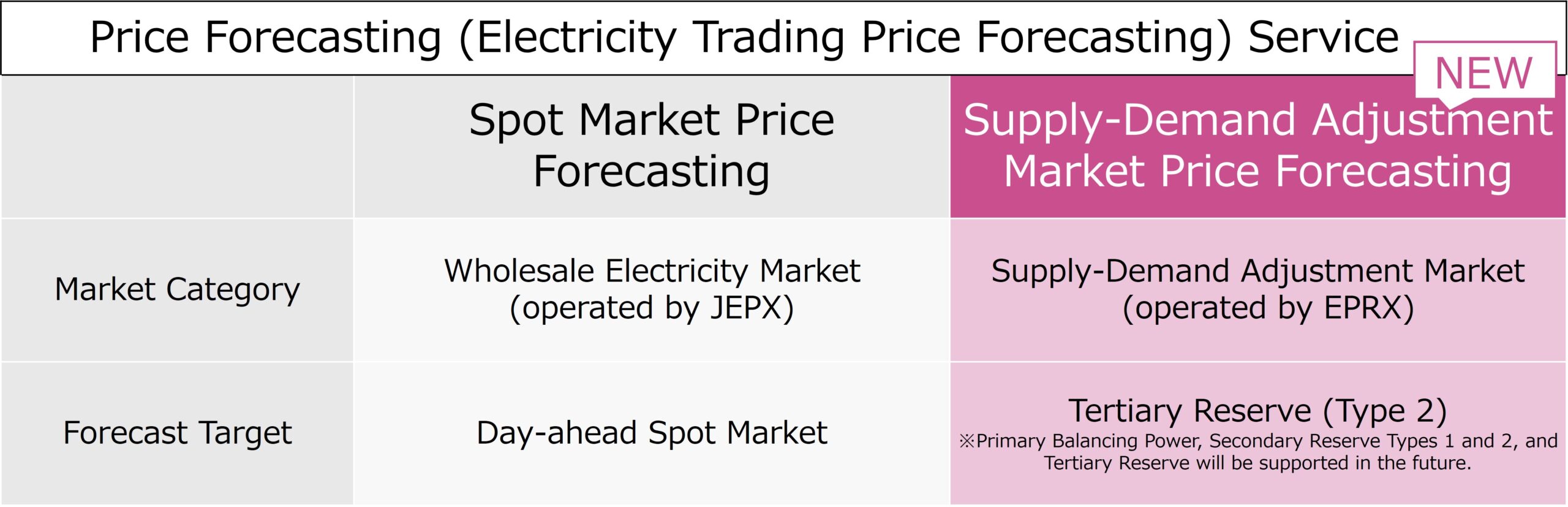
List of "Price Forecasting (Electricity Trading Price Forecasting)" Services
◆ Overview of " Supply-Demand Adjustment Market Price Forecasting"
This forecasting service accurately predicts the day-ahead clearing prices for the Tertiary Reserve (Type 2) in the supply-demand adjustment market at 30-minute intervals, and also supports the [30-minute block bidding] system introduced in March 2025.
By incorporating Supply-Demand Adjustment Market prices, spot market prices, electricity demand, and weather forecast data together with associated uncertainty information, the reliability of forecasts has been enhanced.
Since renewable energy forecast errors directly influence the required volume of balancing capacity(5), incorporating uncertainty information related to forecast errors enables more precise forecasting.
When combined with the “Spot Market Price Forecast” for the wholesale electricity market (operated by JEPX (6)), this service supports decision-making when selecting target electricity markets, for example, bidding into the supply–demand adjustment market when the forecasted clearing price exceeds the previous day’s spot market price forecast.
Furthermore, JWA supports battery storage operators in maximizing electricity sales revenue from grid-scale battery and assists resource aggregators (7) in formulating power sales plans. Going forward, JWA plans to expand functionality to cover Primary Balancing Power, Secondary Reserve Types 1 and 2, and Tertiary Reserve Type 1.
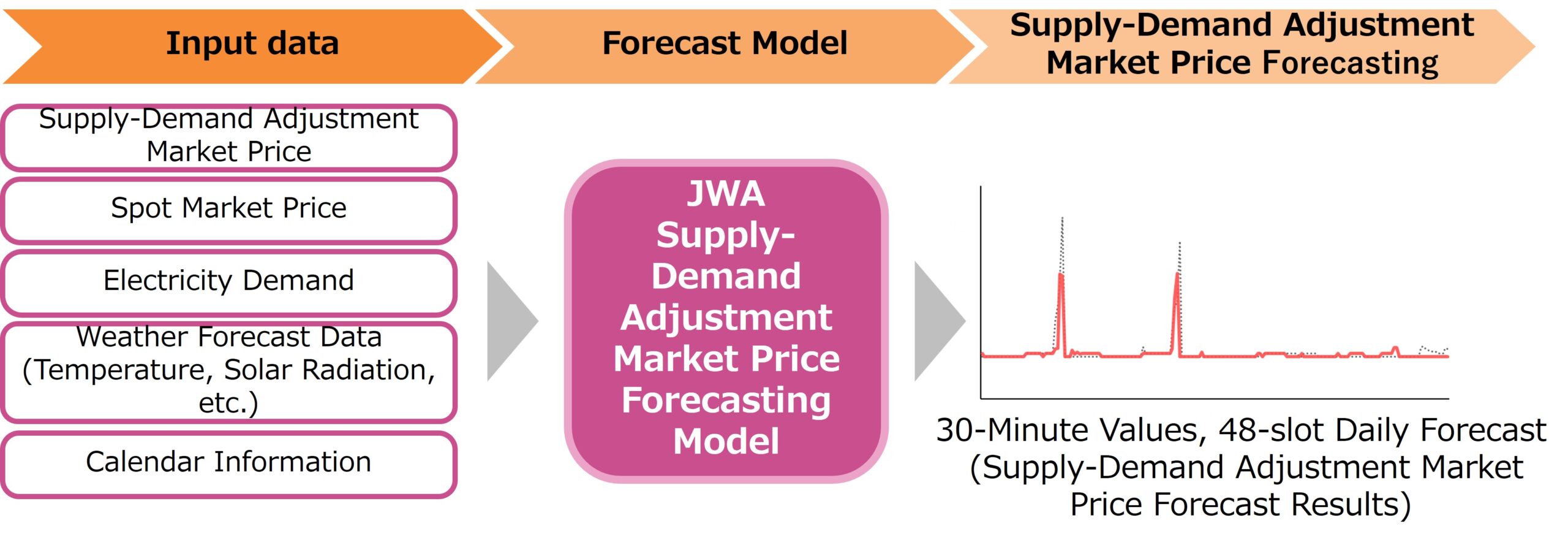
Overview of the " Supply-Demand Adjustment Market Price Forecasting"
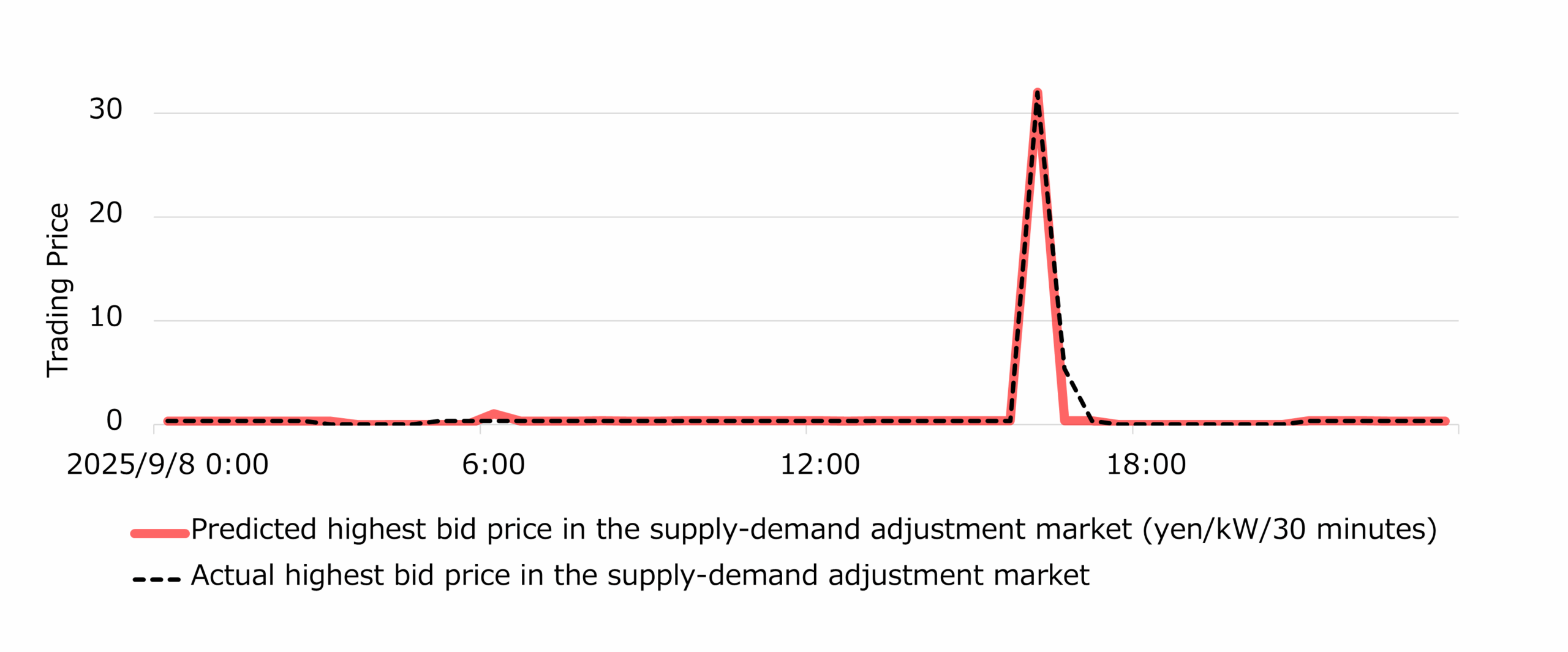
Examples of forecast results for " Supply-Demand Adjustment Market Price Forecasting"
* Edited by Japan Weather Association based on “Supply-Demand Adjustment Market Transaction Performance Data” by the EPRX
Corrected and reissued on February 5, 2026: The graph image has been corrected due to some errors in the data.
1. Background
Japan Weather Association’s Price Forecast (Electricity Market Transaction Price Forecast) Service, launched in 2017, initially targeted the wholesale electricity market. However, with the expansion of renewable energy deployment and the advancement of grid operations, the supply–demand adjustment (balancing) market was established in 2021, and the importance of balancing power transactions has increased rapidly.
Electricity market prices fluctuate significantly due to weather and electricity demand, requiring energy-related businesses to rely on highly accurate price forecasts when making bidding decisions and formulating operational plans.
Prices in the supply–demand adjustment market are particularly subject to high uncertainty and have a direct impact on business revenues, making precise price forecasting essential for maximizing profitability. To address this need, JWA has developed “Supply-Demand Adjustment Market Price Forecasting,” a service tailored specifically to this market.
2. Specifications
The specifications for the provision of ” Supply-Demand Adjustment Market Price Forecasting” are as follows:
| Forecast Type | Next-day forecast |
|---|---|
| Forecast Period | Next-day delivery |
| Number of Releases | Twice daily (15:00 two days before the delivery date and 08:00 on the day before the delivery date) |
| Forecast target | Supply-demand adjustment market, Tertiary Reserve (Type 2) Highest/Average/Lowest Bid Price (yen/kW/30 minutes, 48-slot per day) |
| Delivery Method | Online distribution (API integration, email distribution, etc.) |
| File formats | JSON format/CSV format (via API) XML format (via email) |
* Support for Primary Balancing Power, Secondary Balancing Power (Types 1 and 2), and Tertiary Balancing Power (Type 1) will be added sequentially in the future.
3. Applications
- Decision-making by energy-related businesses when selecting target electricity markets
- Maximization of electricity sales revenue from grid-scale batteries by storage operators
- Formulation and monetization of power sales plans by resource aggregators
- Assessment of power sales profitability by electricity trading businesses
4. Service start date
Thursday, January 22, 2026
5. Inquiries regarding service details and implementation (for businesses)
Japan Weather Association, Environment and Energy Division, Business Support Office
Email: ke-eigyo_kankyo@jwa.or.jp
*If you are a member of the media, please contact the Japan Weather Association Public Relations and Communications.
(Note 1) EPRX (Electric Power Reserve Exchange)
Electric Power Reserve Exchange (EPRX) is a general incorporated association that operates the supply-demand adjustment market, facilitating the wide-area and efficient trading of “balancing capacity” to adjust electricity supply-demand.
(Note 2) Tertiary Reserve (Type 2)
A product designed to address forecast errors of renewable energy using FIT Special Measures Scheme 1 and FIT Special Measures Scheme 3. It is structured to allow participation from a variety of power generation resources.
(Note 3) Grid-scale Battery
Large-scale battery storage systems directly connected to the power grid (transmission and distribution network) that help stabilize the grid and perform supply–demand adjustments.
(Note 4) Primary Balancing Power, Secondary Reserve Types 1 and 2, and Tertiary Reserve type 1
Commodities traded in the supply–demand adjustment market. They are classified according to response time (ranging from several seconds to several minutes, or tens of minutes to hours) and command method, resulting in categories such as Primary Balancing Power, Secondary Reserve Types 1 and 2, and Tertiary Reserve Type 1.
(Note 5) Required Balancing Capacity
The volume of balancing power procured by transmission and distribution operators in the supply–demand adjustment market to perform frequency regulation and supply–demand adjustment.
(Note 6) JEPX (Japan Electric Power Exchange)
The wholesale electricity market where power generators, retail electricity suppliers, and other market participants trade electricity based on supply and demand.
(Note 7) Resource Aggregator
An entity that aggregates multiple distributed energy resources, such as distributed generation units and energy storage systems, and participates collectively in markets such as the supply-demand adjustment market. By aggregating these resources, the aggregator provides balancing capacity.
◆Related services
Price forecasting (electricity market price forecasting)
Electric power demand forecasting