
- Home
- News
- JWA 2026 Spring Pollen Dispersion Forecast (Part 2)
~Dispersion to Begin Across a Wide Region by Late February;
Peak Expected in Many Areas from Early March~
News
JWA 2026 Spring Pollen Dispersion Forecast (Part 2)
~Dispersion to Begin Across a Wide Region by Late February;
Peak Expected in Many Areas from Early March~
2026.02.25
Press Release
On February 19, 2026, Japan Weather Association (JWA) released Part 2 of its Spring 2026 Pollen Dispersion Forecast.
Timing of the Start of Cedar Pollen Dispersion
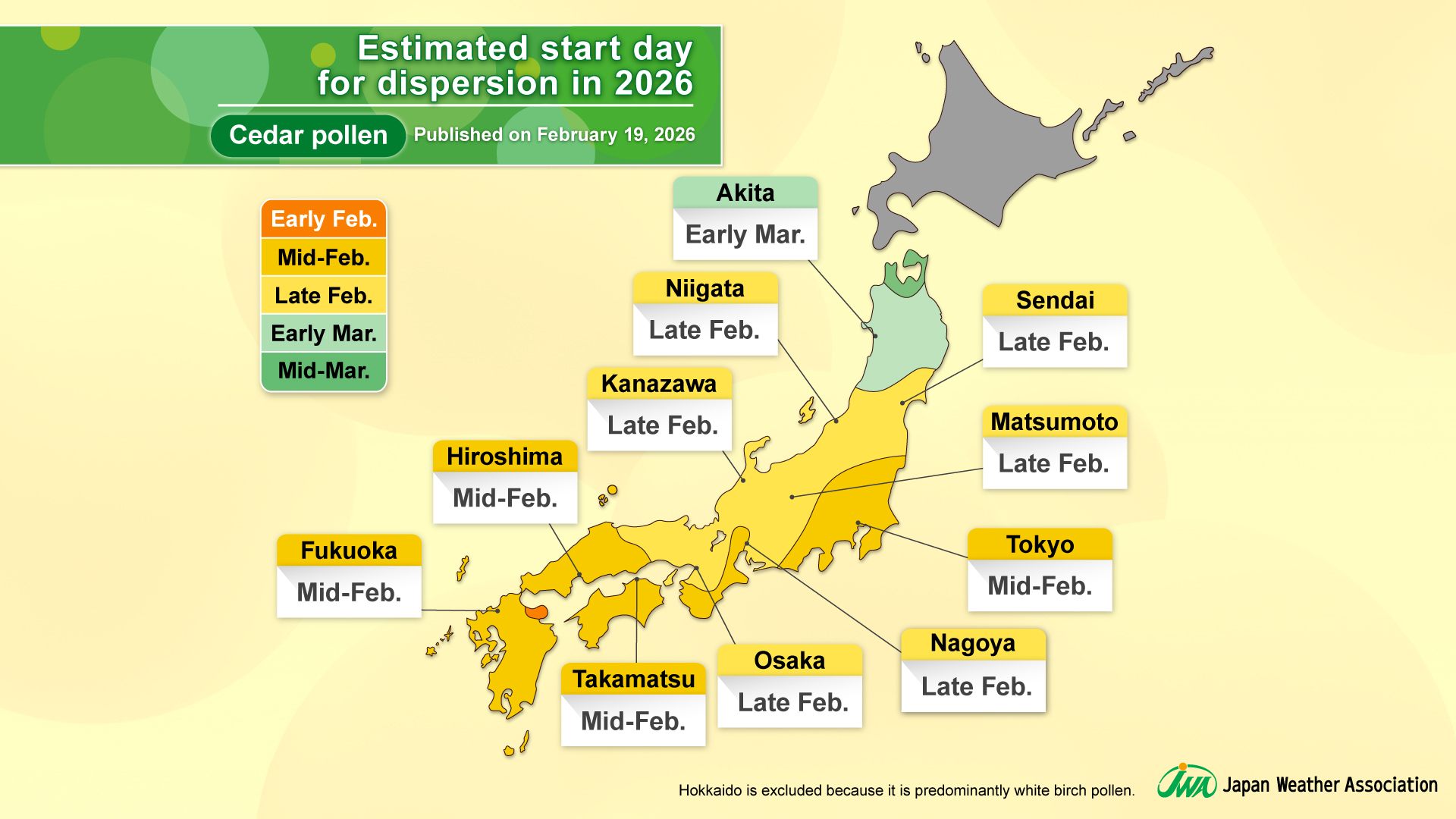
Based on observations through February 16, the start of cedar pollen dispersion has been confirmed in parts of the region from Kyushu to Tokai, southern Kanto, and parts of southern Tohoku. By late February, dispersion is expected to begin across a wide region from Kyushu to southern Tohoku.
Influenced by below-normal temperatures in early February (Note 1), the start of dispersion from Kyushu to Tokai has tended to be around the usual time or later than usual (Note 2). Temperatures are expected to remain above normal through late February, and significant fluctuations between warm and cold conditions are likely to continue into March. In Kanto-Koshin and from Hokuriku to Tohoku, the start of dispersion is expected to be generally in line with the usual timing, with some areas of Tohoku likely to experience an earlier-than-usual start.
Based on JWA’s observations, the start of pollen dispersion has been confirmed in Tokyo on February 14.
Peak Period
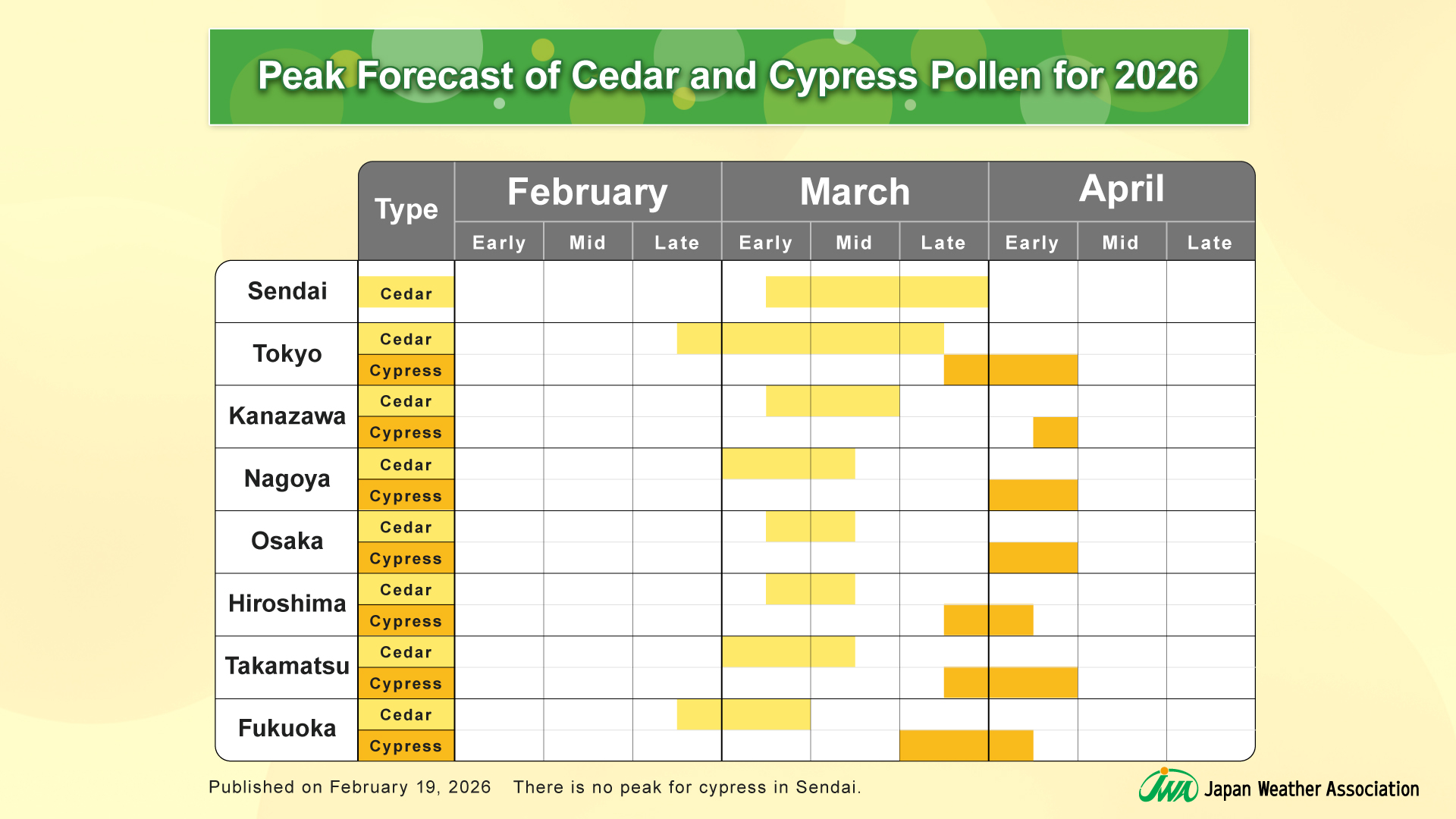
In areas where the peak occurs earlier, such as Fukuoka and Tokyo, cedar pollen dispersion is expected to enter its peak period (Note 3) by the end of February. Across a wide region, the peak is anticipated from early to mid-March. The peak period is expected to last approximately 10 days to one month.
The peak period for cypress pollen is expected from late March to early April, lasting approximately 5 days to two weeks.
From now through March, temperatures are expected to alternate between cold and warm conditions, and on days of sudden warming, pollen concentration is likely to increase sharply. The peak timing for both cedar and cypress pollen is expected to be generally in line with the usual timing.
Pollen Concentration Forecast
For spring 2026, pollen concentration (Note 4) is expected to be generally around the usual level in western Japan. In eastern and northern Japan, however, concentrations are expected to be higher than usual, with some areas experiencing significantly higher levels.
Note 1: “Normal” refers to the 30-year average (1991–2020).
Note 2: “Usual” refers to the 10-year average (2016–2025).
Note 3: “Peak start (end) day” refers to the first (last) day on which 50 or more cedar pollen particles per cm² are observed for two consecutive days. For cypress pollen, it refers to the first (last) day on which 30 or more particles per cm² are observed for two consecutive days.
Note 4: “Pollen” refers to cedar and cypress pollen; in Hokkaido, white birch pollen.
Pollen Dispersal Forecast:
For more information on pollen dispersal forecast, follow the link below;
https://www.jwa.or.jp/english/service/seasonal-news-pollen-dispersal-forecast/
Please refrain from unauthorized corporate use of this information for purposes other than news reporting.
For corporate use, including product promotion, please contact us using the inquiry form provided in the link below.
https://www.jwa.or.jp/english/contact/
PDF DOWNLOAD:JWA 2026 Spring Pollen Dispersion Forecast (Part 2)