
- Home
- News
- Cherry Blossom and Full Bloom Forecast for 2026 (Part 2)
Two weeks until the cherry blossom arrives, with Uwajima on March 18th, followed by Fukuoka, Nagoya and Gifu on the 20th of March.
News
Cherry Blossom and Full Bloom Forecast for 2026 (Part 2)
Two weeks until the cherry blossom arrives, with Uwajima on March 18th, followed by Fukuoka, Nagoya and Gifu on the 20th of March.
2026.03.10
Press Release
Japan Weather Association (JWA) released its part 2 forecast for cherry blossoms and full bloom for 84 locations throughout Japan on Wednesday, March 4th, 2026.
Cherry Blossom Forecast Map
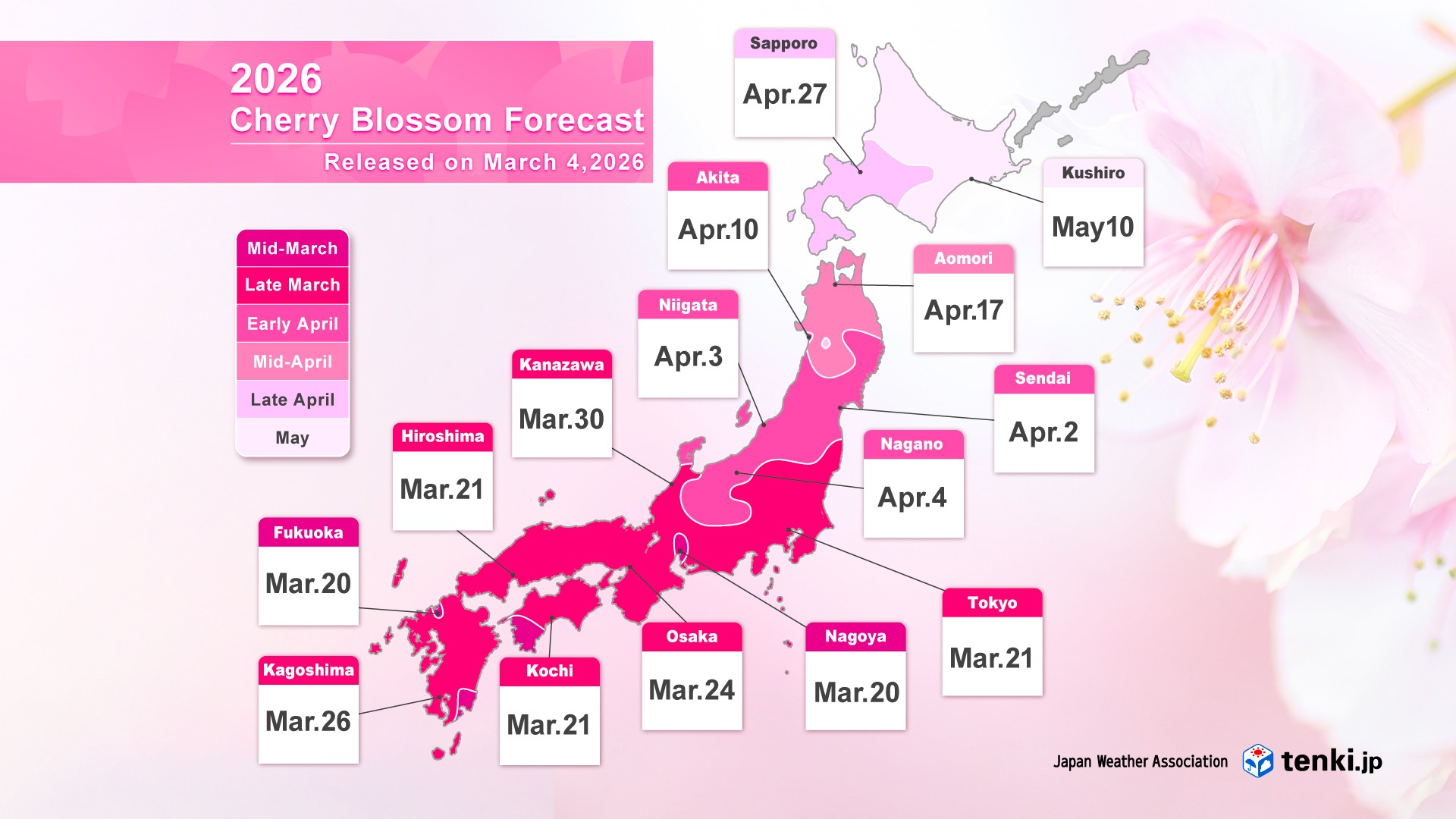
Bloom Forecast Dates (Major Locations)
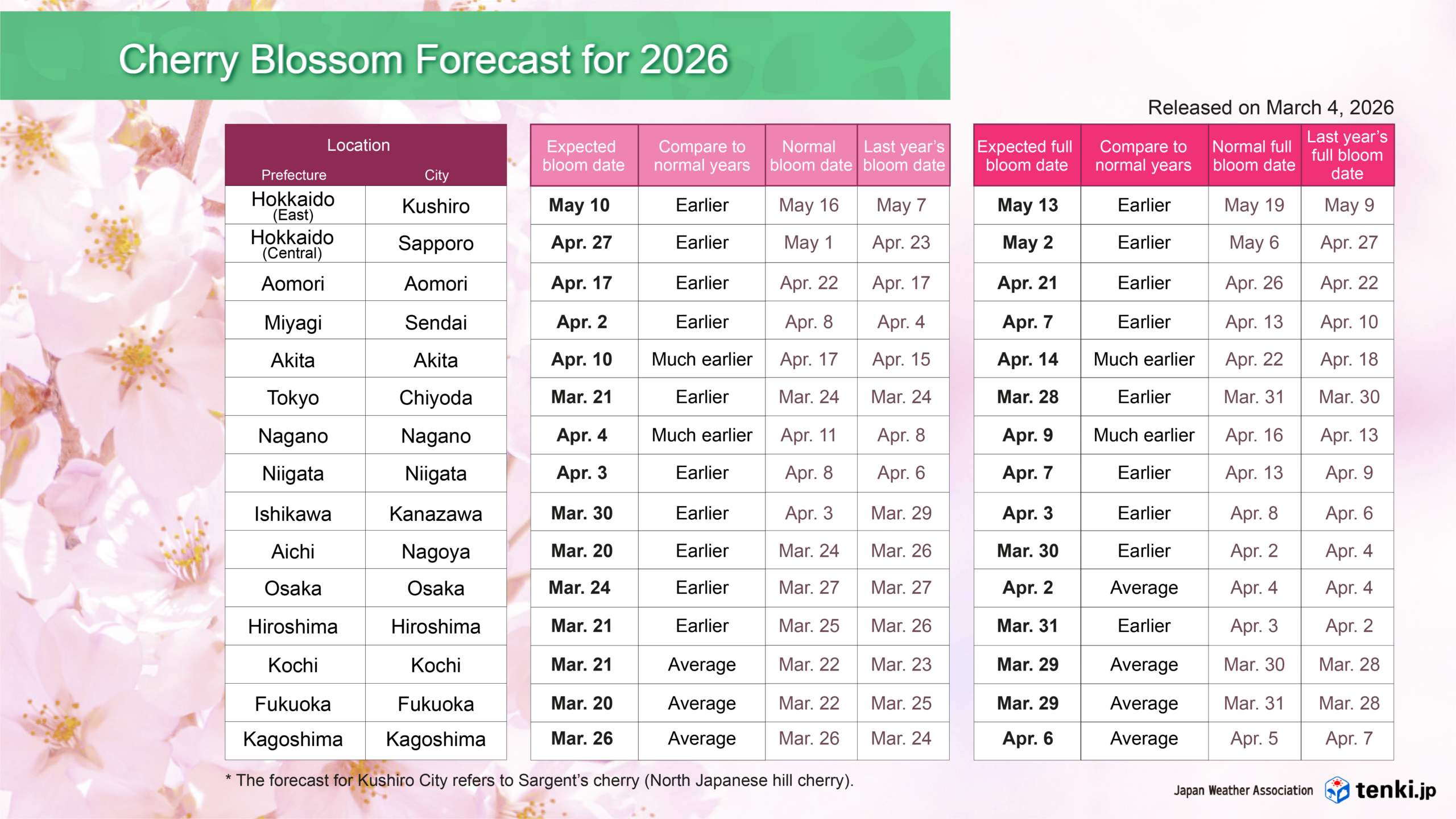
Trend of Blossoming and Full Bloom
For the 2026 cherry blossom season, the blooming and Full bloom is expected to be around average or earlier than average in western Japan, and earlier than average in many areas of eastern and northern Japan.
The first location expected to bloom is Uwajima in Ehime Prefecture1, with the blossoming expected to arrive on March 18th. The sample trees under observation by the local meteorological observatories in Fukuoka, Nagoya and Gifu are expected to bloom on the 20th, closely followed by the trees in Kochi, Hiroshima, Tokyo and some wider areas on the 21st of March. Osaka is expected to bloom on the 24th, Kanazawa on the 30th, and the wider area from Kyushu to Hokuriku is anticipated to bloom by the end of March.
From April, the bloom is expected to arrive in Sendai on the 2nd, and Aomori on the 17th of April, with the cherry blossom front finally reaching Sapporo on the 27th.
For Full Bloom, Uwajima is expected to reach the blooming peak first on March 25th, then among the meteorological observatories’ sample trees, Tokyo is expected to reach Full Bloom on the 28th of March, with the wider areas from Kyushu to southern Tohoku reaching full bloom by early April. And then, some wider areas of Hokkaido will be able to enjoy the cherry blossoms in Full Bloom during the Golden Week holidays2.
1The information for Uwajima is not from sample trees of the meteorological observatories, but from independent observation points of JWA.
2The 2026 Golden Week in Japan runs from April 29th to May 6th.
Basis of the Blossoming Predictions
From mid-February this year, Japan has experienced unseasonably warm weather, which likely has accelerated the cherry blossom buds’ development.
Looking ahead into the second half of March, the unusual high temperatures in the latter part of February are expected to subside, with the forecast predicting temperatures around average or slightly higher than average.
For the western part of Japan and the Kanto region, the temperature for March is now expected to be lower than earlier predicted, so the flowering date has been moved approximately one day later than earlier forecasted. Meanwhile in the Tokai region, the predicted flowering date has been brought forward due to the temperatures being higher than expected in the period from February to early March.
Lastly, the forecasted temperatures for April and onwards are expected to have no significant change from the previous forecast, with temperatures expected to remain higher than average in northern Japan.
The cherry blossom and full bloom forecast for all 84 locations is available on tenki.jp, a weather forecast media site below operated by JWA.
https://tenki.jp/sakura/expectation/
Cherry Blossom Forecast
For more detailed information about JWA’s Cherry Blossom Forecast, please find the link below.
https://www.jwa.or.jp/english/service/seasonal-news-cherry-blossom-forecast/
【Description of words】
Normal: Average of 1991-2020
Much earlier: 7 or more days earlier than normal
Earlier: 3 to 6 days earlier than normal
Average: within two days of the normal date
Later: 3 to 6 days later than normal
Much later: 7 or more days later than normal
Reference material
Frequently asked questions regarding cherry blossom forecast
-
A
Here are the scheduled releases:
Part 1: January 29th (Thursday)
Part 2: March 4th (Wednesday)
Part 3: Mid-to-late March
Part 4: Early April
*The release schedule may change in the future. -
A
The criteria are the same as those used by the Japan Meteorological Agency. The blooming date is defined as the first day when five to six or more flowers have opened on the designated observation tree (i.e. sample tree), and the full bloom date is the first day when more than 80% of the buds have opened on the sample trees.
-
A
Forecasts are announced for 53 locations in January and February, and for 84 locations nationwide from March onward. The forecast locations consist of 53 sample trees observed by local meteorological observatories and 31 additional locations where observation data are obtained from cooperating organizations such as municipalities / local governments and parks.
-
A
We use our proprietary forecasting model that focuses on the temperature trends from autumn onwards, which significantly influence the growth process of the cherry blossom buds. Our forecasts are based on accurate observation data from sample trees at local meteorological observatories and cooperating agencies, emphasizing meteorological principles. Japan Weather Association has been conducting cherry blossom forecasts since 2007, making this year the 20th year of our endeavour.
-
A
The following data are used.
- Temperature observation data from the previous autumn to the forecast date
- Temperature forecast data from the forecast date to the blooming period (from Japan Weather Association’s point forecasts and long-term forecasts).
The temperature from the previous autumn to spring significantly influences the cherry blossoming period. Cherry buds form during the previous summer and then enter dormancy. Exposure to a certain period of low temperatures during winter breaks this dormancy, and the buds grow and bloom with rising temperatures. It is believed that higher temperatures promote faster bud growth and earlier blooming.
PDF DOWNLOAD:Cherry Blossom and Full Bloom Forecast for 2026 (Part 2)