
- Home
- News
- Cherry Blossom and Full Bloom Forecast for 2026 (Part 4)
The cherry blossom front is moving northwards,
with the blossoming arriving about 10 days earlier than average in many areas
News
Cherry Blossom and Full Bloom Forecast for 2026 (Part 4)
The cherry blossom front is moving northwards,
with the blossoming arriving about 10 days earlier than average in many areas
2026.04.10
Press Release
Japan Weather Association (JWA) released its part 4 forecast for cherry blossoms and full bloom for 84 locations throughout Japan on the 8th of April.
Cherry Blossom Forecast Map
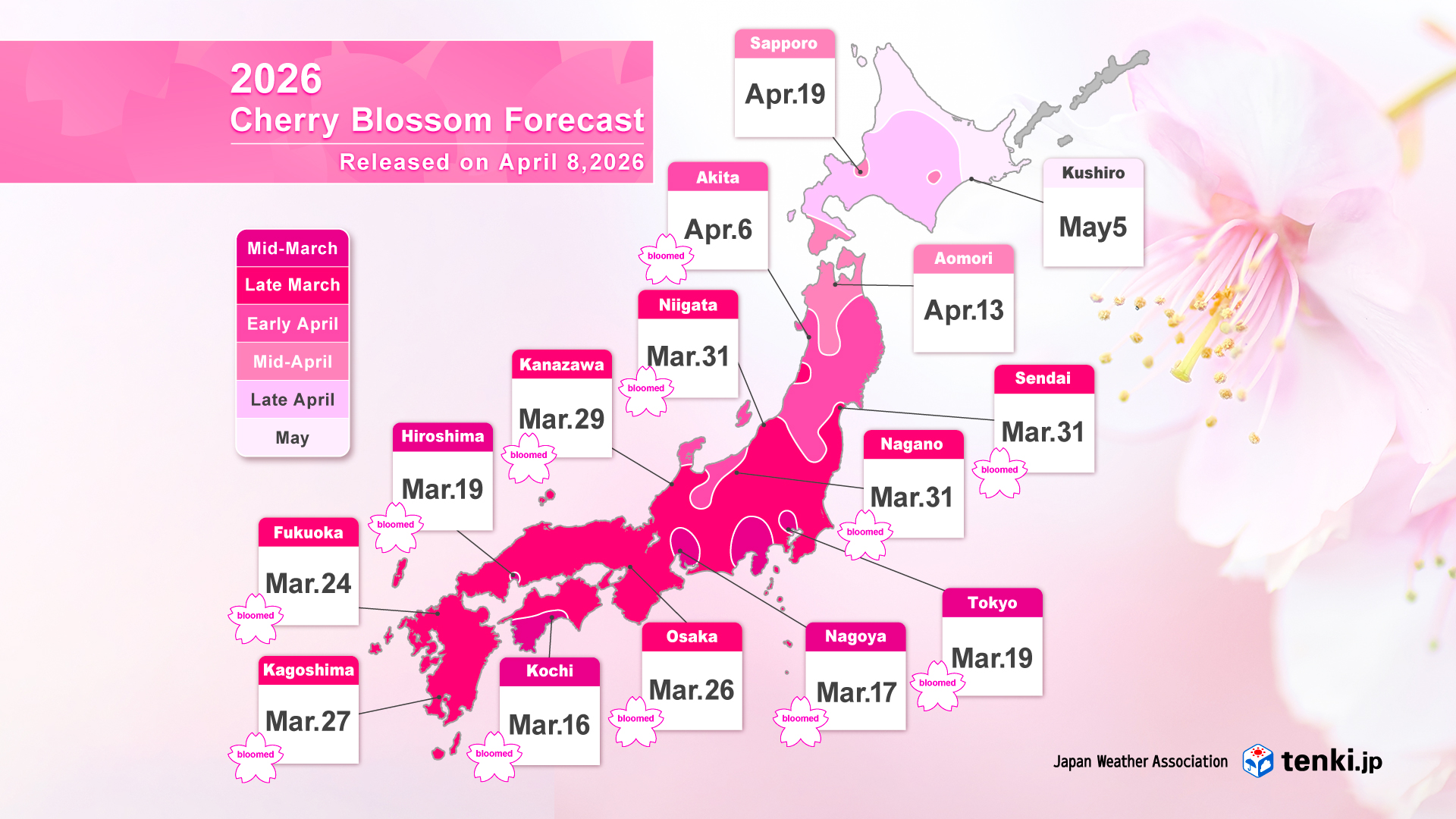
Blossoming & Full Bloom Forecast Dates (Major Locations)
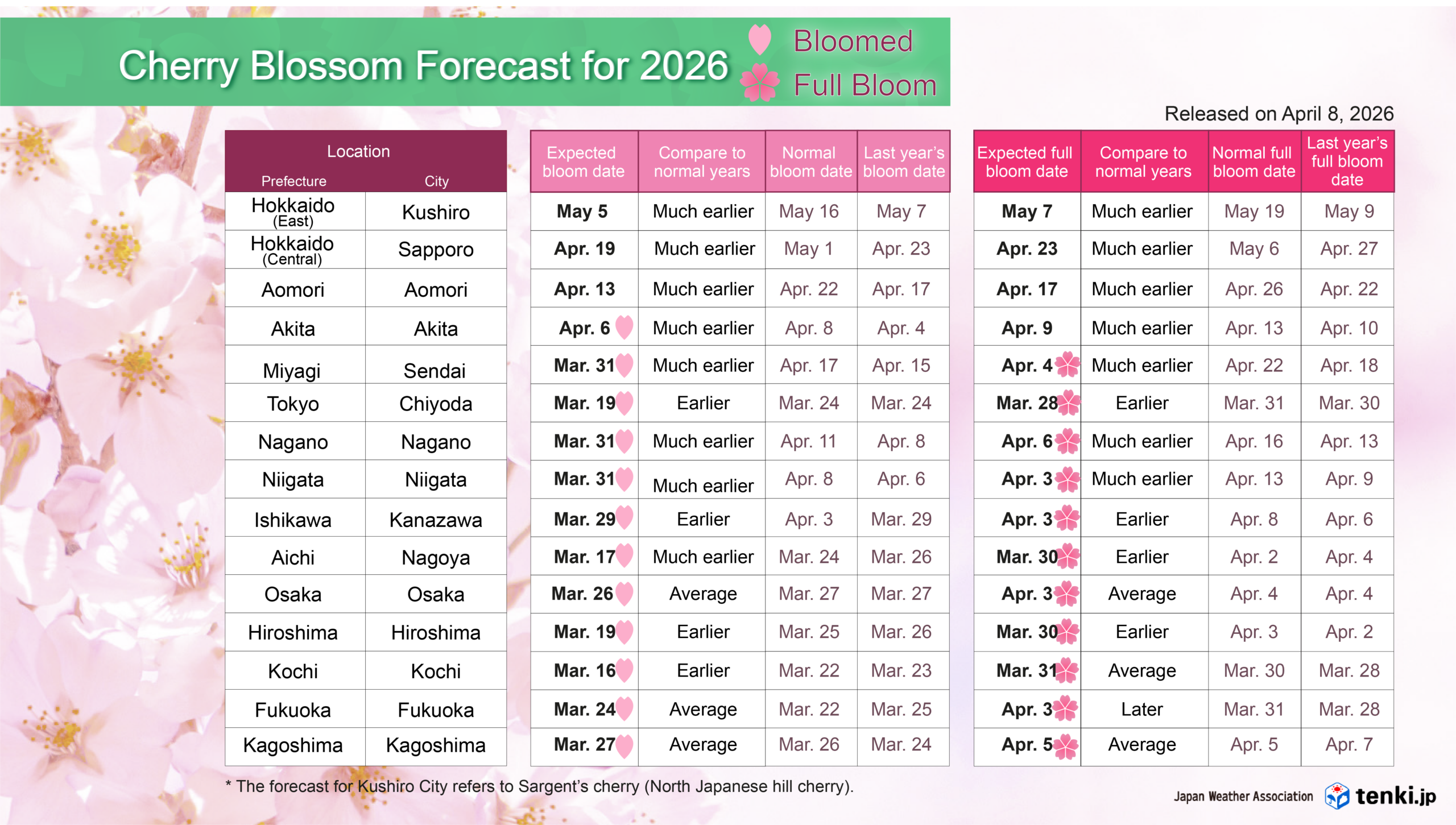
Summary of the 2026 Cherry Blossom Season
In western and eastern Japan, for many areas the cherry blossoms have blossomed and reached Full Bloom earlier than average this year.
As the high temperatures from March have persisted in northern Japan, and the same trend is expected to continue into April and onwards, many areas in northern Japan is likely to experience an earlier than average blossoming and Full Bloom season this year.
Trend of Blossoming
From Kyushu to southern Tohoku, cherry blossoms have bloomed at all observation points, with many locations reporting an earlier than average blooming.
In northern Japan, reports of blossoming arrived from Yamagata on 2nd April, Akita on 6th of April and Morioka on 7th April, indicating that the cherry blossoms are progressing northward through the Tohoku region at a considerably faster pace than average.
Further north, many areas in northern Tohoku and Hokkaido are also expected to see this year’s cherry blossom significantly earlier than average. Aomori is expected to see the arrival of blossoms on the 13th, and Sapporo on the 19th, making it the second earliest bloom on record for Aomori and the third earliest record for Sapporo.
Trend of Full Bloom
Cherry blossoms are now in Full Bloom across various regions from Kyushu to southern Tohoku, while many areas in Kyushu and Shikoku are reaching Full Bloom at around the average time, from the Chugoku region to southern Tohoku, Full Bloom has arrived earlier than average.
This year, Full Bloom arrived in the northern prefectures Niigata on April 3rd and Yamagata on April 6th, 10 and 12 days earlier than average respectively, resulting in Full Bloom occurring simultaneously in both the northern part of the country and the southern island of Kyushu.
Looking ahead, many areas in northern Tohoku and Hokkaido are expected to see the cherry blossoms in Full Bloom about 10 days earlier than average. Full Bloom is expected to arrive in Aomori on the 17th and in Sapporo on the 23rd, making it the third earliest Full Bloom on record for Aomori and the second earliest for Sapporo.
The cherry blossom and full bloom forecast for all 84 locations is available on tenki.jp, a weather forecast media site below operated by JWA.
https://tenki.jp/sakura/expectation/
Cherry Blossom Forecast
For more detailed information about JWA’s Cherry Blossom Forecast, please find the link below.
https://www.jwa.or.jp/english/service/seasonal-news-cherry-blossom-forecast/
【Description of words】
Normal: Average of 1991-2020
Much earlier: 7 or more days earlier than normal
Earlier: 3 to 6 days earlier than normal
Average: within two days of the normal date
Later: 3 to 6 days later than normal
Reference material
Frequently asked questions regarding cherry blossom forecast
-
A
Here are the scheduled releases:
Part 1: January 29th (Thursday)
Part 2: March 4th (Wednesday)
Part 3: March 18th (Wednesday)
Part 4: April 8th (Wednesday)
*This is the final forecast for this year’s cherry blossom blooming and full bloom. -
A
The criteria are the same as those used by the Japan Meteorological Agency. The blooming date is defined as the first day when five to six or more flowers have opened on the designated observation tree (i.e. sample tree), and the full bloom date is the first day when more than 80% of the buds have opened on the sample trees.
-
A
Forecasts are announced for 53 locations in January and February, and for 84 locations nationwide from March onward. The forecast locations consist of 53 sample trees observed by local meteorological observatories and 31 additional locations where observation data are obtained from cooperating organizations such as municipalities / local governments and parks.
-
A
We use our proprietary forecasting model that focuses on the temperature trends from autumn onwards, which significantly influence the growth process of the cherry blossom buds. Our forecasts are based on accurate observation data from sample trees at local meteorological observatories and cooperating agencies, emphasizing meteorological principles. Japan Weather Association has been conducting cherry blossom forecasts since 2007, making this year the 20th year of our endeavour.
-
A
The following data are used.
- Temperature observation data from the previous autumn to the forecast date
- Temperature forecast data from the forecast date to the blooming period (from Japan Weather Association’s point forecasts and long-term forecasts).
The temperature from the previous autumn to spring significantly influences the cherry blossoming period. Cherry buds form during the previous summer and then enter dormancy. Exposure to a certain period of low temperatures during winter breaks this dormancy, and the buds grow and bloom with rising temperatures. It is believed that higher temperatures promote faster bud growth and earlier blooming.
PDF DOWNLOAD:Cherry Blossom and Full Bloom Forecast for 2026 (Part 4)