
- Home
- Services & Solutions
- Environmental Impact Assessments
- “Bird Monitoring System” – tailored service for wind farms
Services & Solutions
“Bird Monitoring System” – tailored service for wind farms
The bird monitoring system allows 24-hour continuous remote monitoring of birds flying in the vicinity of wind turbines. In offshore wind power, this system will play an active role as a method for post-survey and environmental monitoring.
Conventional bird strike surveys for onshore wind power mainly consist of habitat surveys i.e., visual surveys in the vicinity of wind turbines, and carcass surveys by tramping the wind turbine foundations. On the other hand, surveys of offshore wind turbines require approaching the wind turbines by boat, which is less accessible and difficult in strong winds and stormy weather, and the carcasses are usually washed away.
Therefore, a bird monitoring system using radar and/or the combination of infrared camera and AI would allow remote monitoring and solves issues specific to both onshore and offshore wind turbines.
Bird Monitoring System
Summary
The bird monitoring system allows 24-hour continuous remote monitoring of birds flying in the vicinity of wind turbines. It consists of:
(1) Bird Track Extraction System
(2) Bird Strike Detection System
In offshore windfirm management, this system will play an active role as a method for post-survey and environmental monitoring.
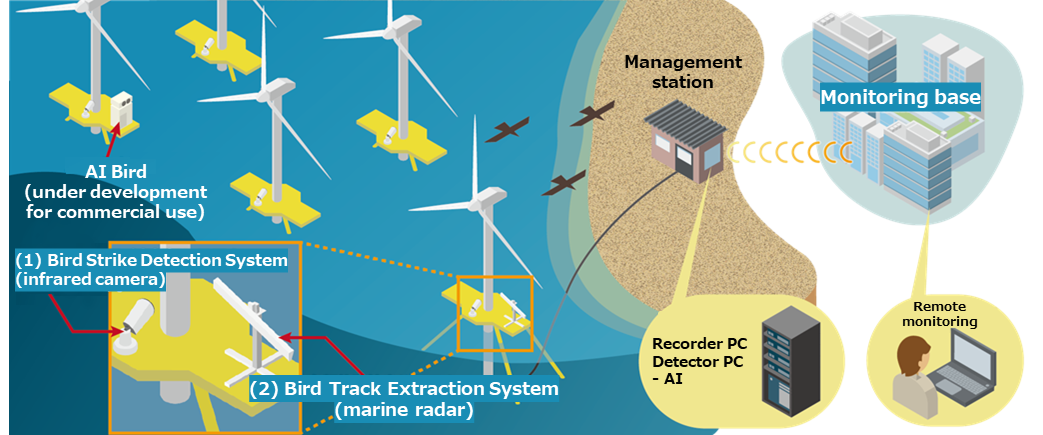
Fig. Overview of Bird Monitoring System
① Bird Track Extraction System using marine radar
Two types of marine radar (S-band and X-band) may be used to quantitatively determine the direction and altitude of birds in flight. Each radar can observe within a radius of 16 km (horizontal observation) and 2 km (vertical observation) to monitor constantly the habitat conditions and migratory routes of birds.
– 24/7 observations, including nighttime surveys are possible for long periods and wide-area offshore observations where visual surveys are difficult to implement.
– Extraction of flight direction and altitude from the flight trajectory is possible.
– Quantitative understanding of flight routes and peak times is reported.
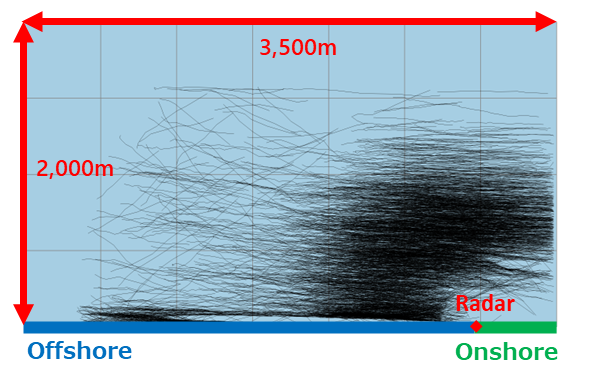
Fig. Example of bird flight trajectories
② Bird Strike Detection System coupled with infrared cameras and AI
The system monitors and automatically detects approaching birds in the vicinity of wind turbines by capturing videos via an infrared camera and detecting flying objects using AI. It provides constant monitoring of bird strike occurrence in offshore wind farms, where it is difficult to survey carcasses.
– The use of 24/7 monitoring and nighttime survey is possible.
– Prompt reporting of bird strike occurrence.
– AI-based automatic detection improves the efficiency of monitoring operations.
– Re-learning by AI improves accuracy.
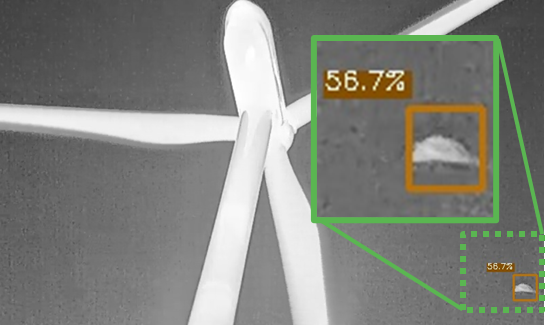
Fig. AI detects flying objects
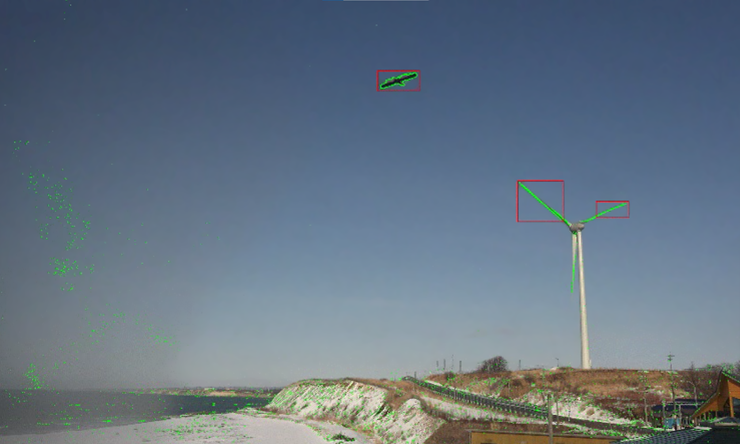
“AI Bird” identification system (under development for commercial use)
“AI Bird” is the first system in Japan to use AI to identify specific bird species from footage captured by 4K cameras. The system can improve the accuracy of identification by repeatedly learning from footage taken at the same location. In cases where the system has been verified with the rare bird species; White-tailed and Steller’s sea eagles, the reproduction rate* was 94%.
The system has been developed in 2021 and now under development for commercial use.
*Percentage of images in which the AI correctly detects the target.
Service brochure
Download the service brochure for the Avian Surveillance System below.
| Japanese brochure here (日本語) |
|---|
| English brochure here (English) |
| Vietnamese brochure here (Tiếng Việt) |
| French brochure here (Français) |
For questions or requests about this system, please contact below.
Japan Weather Association
Sunshine 60 Bldg.55F 3-1-1 Higashi-Ikebukuro, Toshima-Ku, Tokyo 170-6055 Japan
Tel.+81-3-5958-8142
Mail: ke-eigyo_kankyo@jwa.or.jp
Related News
-
Press Release
Japan Weather Association joins Taiwan’s “Ex-post Birds Survey Work on Offshore Wind Power Generation” with “Birds Migration and Collision Monitoring Technology” ~Japan’s Birds Monitoring Technology adopted for infrastructure equipment overseas for the first time~
-
Press Release
AI bird identification system has been developed. ~Contributing to the coexistence of rare wild animals and wind power generation business with new technology
~
Contact an expert for this service.

Services & Solutions Services & Solutions
-
Electric Power Demand Forecast
-
Solar Power Generation
-
Wind Power Generation
-

Environmental Impact Assessments
-

Disaster Mitigation・Crisis Management・Climate Change Measurements
-

Transport (Roads, Rails, Air, Oceans)
-
Meteorological and Oceanographic Forecasts & Real-Time Data Provisioning
-

Manufacturing, Retail, Advertising, and Marketing
-

tenki.jp & Media Services
-
Web, Apps and Other Services